
About the founder
Jack HuynhRigzin Dorje
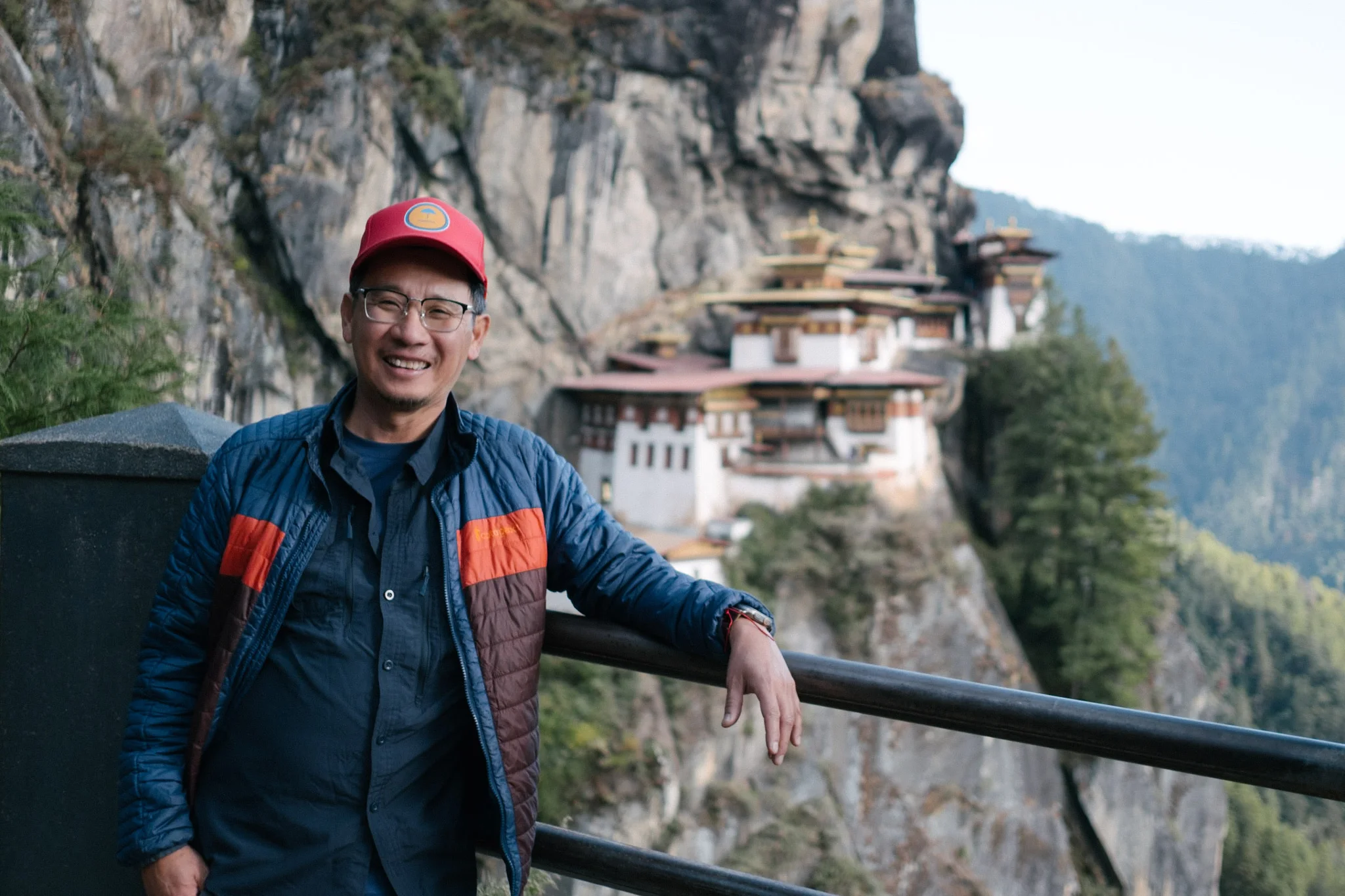
Photographer, Dharma practitioner, and founder of Beyond the Cushion — after more than twenty-five years of navigating the path, through devotion and doubt, progress and distraction.
From his teachers
In the words of his sangha

Khenpo Tshering Chophel
Spiritual Director, Karuna Buddhist Center
Jack (Rigzin Dorje) has been my dedicated student and Dharma practitioner for many years, and his commitment to the Dharma is sincere and firm. What touches me most is that his practice does not stay only on the cushion — it rather naturally flows into all the actions he does in the process of serving others.
In fact, as an integral part of our community (Karuna Buddhist Center) in the last many years he has offered so much to our organization through his photography, design, communication, and his ability to connect with people, always in the spirit of service.
As his teacher and Kalyanamitra, I have seen how his dedication to Dharma practice has matured into genuine wisdom, and that wisdom quietly shows in everything he does. This project feels like a natural expression of who he is: someone with a sincere heart, clear vision, and the determination to bring it into the world.

Lama Nancy Burks
Executive Director, Karuna Buddhist Center
Jack Huynh is a longtime sangha member whose superpowers are his boundless energy and his enthusiasm to serve beings. His project, Beyond the Cushion, reflects this passion and compassion. Jack seeks to do his part to make the world a better place by fostering understanding and connections, both within the Buddhist community and among all people, and his personal perspective (Asian born, American raised) well positions him to explore and illuminate the growth of American Buddhism in its many flowerings.
Skillfully organizing a storehouse of photos, recordings, and ideas, Jack shows us how the wisdom traditions of Asian cultures can create new hybrids that retain lineage and meaning while being accessible and relevant in this time and place. Thank you, Jack!
Spiritual history
Rediscovering the Dharma on his own terms
Beginnings
Born into a Buddhist household
Bay Area
Long retreats at Spirit Rock and other Insight centers
Turning point
Pointing-out instructions on retreat with Tsoknyi Rinpoche
Searching
Retreats with Tibetan teachers, looking for a formal guide
The pandemic
Ngöndro begins through Pema Ösel Ling
Ann Arbor
Karuna Buddhist Center and the Karma Kagyu lineage under Khenpo-la
Now
Ann Arbor, Denver, and the open road
I was born into a Buddhist household, but my path was anything but straightforward. Like many second-generation practitioners, I had to rediscover the dharma on my own terms. That rediscovery began after college, during my years in the Bay Area, where I immersed myself in long retreats at Spirit Rock and other Insight centers. The teachings made sense intellectually, but it was the direct, experiential clarity of retreat practice that transformed me from someone who understood the dharma to someone who genuinely wanted to live it.
For the first decade, my practice was firmly rooted in the Theravāda and Insight traditions, shaped by teachers like Jack Kornfield and others who carried that lineage into the West. But everything shifted after a profound retreat with Tsoknyi Rinpoche, where I unexpectedly received pointing-out instructions. That moment cracked something open. It left me with a powerful longing to find a teacher, and I spent the following years attending retreats with Mingyur Rinpoche, Khandro Rinpoche, Tenzin Wangyal Rinpoche, and Sogyal Rinpoche. Despite my commitment, I struggled to make progress without a formal guide. Even as I regularly attended Aman Thuten’s sangha toward the end of my time in the Bay Area, ngöndro still wasn’t being taught there, and I felt myself hovering on the threshold of something I couldn’t yet enter.
When I relocated to the Midwest during the pandemic, I finally began my ngöndro through Lama Tharchin Rinpoche’s Pema Ösel Ling, a community where I had already spent significant time in retreat. In Ann Arbor, I had the great fortune to support Lama Nancy of the Ann Arbor KTC and the founding of Karuna Buddhist Center under Khenpo Chophel. Serving on the board and the steering committee gave me a firsthand view of the challenges and beauty of building a sangha from the ground up. Through this relationship, I formally shifted my ngöndro into the Karma Kagyu lineage under Khenpo-la’s guidance—a turning point that deepened my practice in ways I had been seeking for years. Nowadays, I am splitting my time between Ann Arbor and Denver, where I manage a dharma inspired airbnb rental aptly named Tara’s Wellness Sanctuary. I also spend a lot of time living in my truck camper, using the great outdoors as practice container and capturing images for my print store.
Now, after more than twenty-five years of navigating the path—through devotion and doubt, progress and distraction, the pull of modern life and the quiet call of practice—my commitment has settled into something steadier and more wholehearted. This project has become a natural extension of that commitment, a way of honoring the lineage, the teachers who shaped me, and the countless practitioners whose stories illuminate how the dharma continues to unfold in our time.

On retreat
“It was the direct, experiential clarity of retreat practice that transformed me from someone who understood the dharma to someone who genuinely wanted to live it.”
Professional background
From the dot-com boom to a life’s work

Jack Huynh
Co-founder, Orange Photography
My professional journey began while I was studying Economics at UC Berkeley in the mid-90s, right as the internet was taking shape. Working IT support for the business school gave me my first access to this emerging world, and I taught myself to code by building small websites after hours. By the time I graduated, I had become fluent enough in web development to join USWeb/CKS, one of the largest internet consulting firms of the era. It was the height of the dot-com boom, and I had the opportunity to work with major brands and learn the rhythms of fast-moving creative agencies. But like many stories from that era, mine came to an abrupt pause with the crash. What ended was not just a job—it marked the end of my first professional identity.
That collapse opened the doorway to photography, which quickly became my full-time focus. Drawing on everything I’d learned in the tech world, I co-founded Orange Photography with colleagues from the agency. From the beginning, I imagined the company as a vehicle that would one day give me the freedom to pursue meaningful personal projects. It took nearly fifteen years for that aspiration to mature into reality, but the seed was always there—quietly waiting.
Although the idea for this Buddhist documentary project emerged in the early 2000s, the realities of building a business and raising a family took center stage for many years. It wasn’t until around 2016 that I had both the professional maturity and the bandwidth to finally immerse myself in it. The project grew slowly but steadily—from a passion project into a full multimedia endeavor.
Now, as I move closer to publishing the book, my vision has evolved once again. Beyond creating a documentary and photographic archive of modern Buddhist practice, I’m turning toward the long-term impact of this work. I’m laying the groundwork for a nonprofit that can carry the mission forward—supporting authentic lineages, uplifting communities, and creating a legacy that, I hope, will extend far beyond this lifetime.
Mid-90s
Economics at UC Berkeley; teaching himself to code
Dot-com boom
Web developer at USWeb/CKS
After the crash
Photography, and co-founding Orange Photography
Early 2000s
The idea for Beyond the Cushion takes root
Around 2016
Full immersion in the project begins
Now
The book, and groundwork for a nonprofit
Podcast interviews
Listen
Field notes from the road
Practice run at Wat Hua Lamphong after a long travel day. 📷
This is only part of the kit. The rest of the cases are video gear for interviews and production in Gelephu, Bhutan, for Project 108 (link in bio).
The street setup is one body, one lens: Fujifilm X-T5 + XF 23mm f/2.
The surprise is the iPhone 17 Pro with a Fjorden grip. It makes the phone ready for street photography and brings the feel of a real camera to it.
Also in the Think Tank Retrospective 7: XF 90mm f/2 · XF 35mm f/1.4 · Ulanzi MT-44 · DJI Neo 2, a game changer for travel selfies.
What`s in your travel bag?
#streetphotography #fujifilmxt5 #xf23mm #fjorden #djineo2 #bangkok #bhutan #gelephu #whatsinmybag

A quick update from behind the scenes.
This past year I`ve been quietly building Beyond the Cushion: a redesigned website, a small creative and technical team, and new ways to explore the stories of the practitioners I`ve photographed and interviewed. I also spent more than three months on the road and completed several retreats with my teacher.
Next week I head to Asia for about a month, starting in Bhutan for Project 108, then on to Cambodia, Vietnam and Thailand.
We`re about to launch a social media campaign for the project. If you`d like to follow along, please follow @beyondthecushion.
#BeyondTheCushion #Buddhism #BuddhistPractice #Dharma #Project108 #Bhutan #TravelPhotography #DocumentaryPhotography #Photographer
While the eye candy of fall is nice bonus, the nippy weather is good for the practice and soul. On my way to iconic hike in the area and stopped by the same spot coming in and out. It was a pretty amazing hike to say the least. #colorfulcolorado #ouray
Can’t decide on what concept of fall I want to lean into today.
Second time in this little gateway mountain town. Did a nice trail run before melting in the hot spring. #orvishotsprings
I don`t spend a lot of time with my night photography, but I`m surprised by the different perspective it provides.
The illusion of the curated life. Even a homemade meal perpetuates the notion that I live a blessed life and it is true on a conventional level. But on the ultimate level, it means I can’t have the cake and eat it too. The more successful we are in samsara,the tighter the handcuff becomes. Alas the dance of the paradox of the spiritual path.
Wrapping up my time in Aspen. Since the weather didn’t cooperate I did only one hike to Maroon Bells and I didn’t realize it was bit of a tourist spot. Glad I finally got to check out Aspen but quite pricey and touristy for my taste. Plenty of other great places in Colorado without the sting.
whatever slight merit i have obtain from this journey, may i dedicate it for the benefit of all beings.
Being a foster parent is really a good buddhist practice. got impermanence, compassion and letting go all roll up in one furball. Abbey is now ready for adoption in the ann arbor area from the @humanesocietyofhuronvalley
I don’t get up early enough but sometimes when I do, the dance between light and perspectives is sublime.
Homage
I pay homage to all the teachers of the past and present I pay homage to all the buddhas and bodhisattvas I pay homage to the sanghas near and far I pay homage to the sublime dharma


