


Adapting to the West
I keep coming back to this question—not just how Buddhism is showing up in the West, but what it’s becoming as it does. Because something real is happening here. You can feel it. A 2,500-year-old tradition moving through a culture that values speed, accessibility, individuality. And in that meeting, something is gained… and something is at risk of being lost.
You see this tension clearly in the way Lama Mark Palden teaches. He comes from a deeply traditional Tibetan lineage, shaped by discipline and structure. But his approach is different from his teacher’s—less rigid, more emotionally attuned, more willing to meet students in the reality of their lives. There’s humility in the way he talks about it, a recognition that the form has to shift if the essence is going to land.
“I’m not trying to be my teacher. My job is to translate this in a way people can actually receive.”But he doesn’t confuse accessibility with dilution. There’s a line he holds, quietly but firmly—adaptation, yes, but not at the cost of depth.
“This isn’t a hobby. If you’re going to do this, you have to take it seriously.”Not everyone, though, is convinced we’re holding that line. Lennell offers a more critical lens. She sees how Buddhism, once filtered through Western culture, can start to mirror the very tendencies it was meant to challenge—individualism, self-optimization, identity-building. It’s a subtle distortion, but a powerful one. When practice becomes about improving the self instead of seeing through it, something fundamental shifts. The Dharma becomes more comfortable—but less transformative.
“Going inward isn’t about serving yourself—it’s about going beyond yourself.”Ani Lodro holds an even longer view. She reminds us that Tibetan Buddhism has only been in the West since 1959—barely a beginning in the lifespan of a tradition. And yet its language is already everywhere. Mindfulness, meditation, tantra, woven into mainstream culture in ways that would have been unimaginable a generation ago. She sees both sides clearly. The spread is positive—it opens the door. But there’s a real danger in stopping at the surface, in mistaking familiarity for understanding.
“These words are everywhere now… but that doesn’t mean they’re understood. A tradition that took thousands of years to develop can’t be understood in a few decades.”And maybe that impatience—this need to compress depth into something quickly digestible—is exactly where some of the deeper challenges begin to show up.
Audio Overview
Listen to the narrative exploring this theme in podcast format.
-Ani Lodro
-Mark
-Lennell
-Sensei Michael
-Gareth


Gareth speaks directly to this. From his perspective, the issue isn’t just misunderstanding—it’s commodification. The way spiritual teachings, once rooted in long-term discipline, are increasingly packaged into short trainings, certifications, and business models. He’s seen what happens when money enters the equation unchecked—how it fractures relationships, distorts intentions, creates confusion about what’s authentic. And he sees similar patterns emerging in the spiritual world.
“Real wisdom takes decades. You can’t compress that into a training and call it complete. There’s a lot of teaching happening—but not always a lot of depth behind it.”It’s not that he rejects the growth. He acknowledges that something important is being built—a culture of mindfulness, of kindness. But without discernment, it becomes difficult for serious practitioners to know where to place their trust.
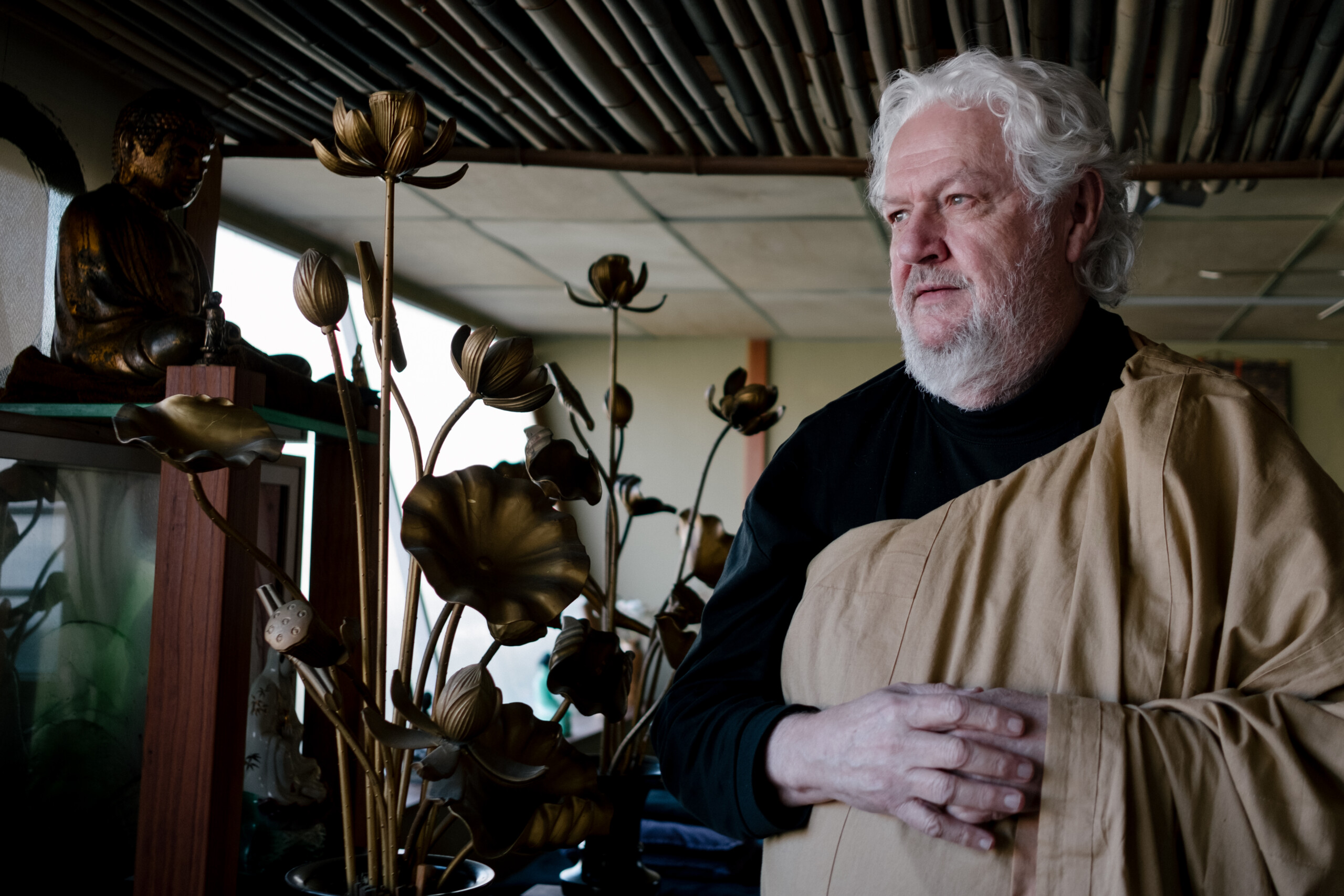
And then there’s another side of this entirely—one that’s more practical, even pragmatic. Sensei Michael describes the spread of Soto Zen in the West almost like a shift in infrastructure. In Japan, temples are everywhere, deeply embedded in the culture. In the West, that simply doesn’t exist. So something has to change. His approach is almost disarmingly straightforward: make it accessible. Train lay practitioners to lead sits, hold discussions, build small communities. Not replacing the tradition, but scaling it in a way that fits Western life—local, approachable, integrated into the everyday.
“If people can’t reach it, they won’t practice. So we bring the practice to them.”
And still, even here, lineage matters. The forms remain. The ceremonies carry weight. The question was never whether to adapt—it’s how to adapt without losing the thread that connects it all back to something real.
When I step back and look at all of this together, it doesn’t feel like a clean story. It feels like a living process. On one side, translation, accessibility, growth. On the other, dilution, misunderstanding, commodification. And in between, teachers and practitioners trying—honestly, imperfectly—to navigate that space with care.
Maybe that’s what Buddhism in the West really is right now. Not a finished form, but an unfolding negotiation. Between old and new. Depth and accessibility. Tradition and culture. And underneath all of it, a quieter question—one I keep sitting with, and maybe you do too:
Are we reshaping the Dharma to fit our lives… or are we willing to let it reshape us?