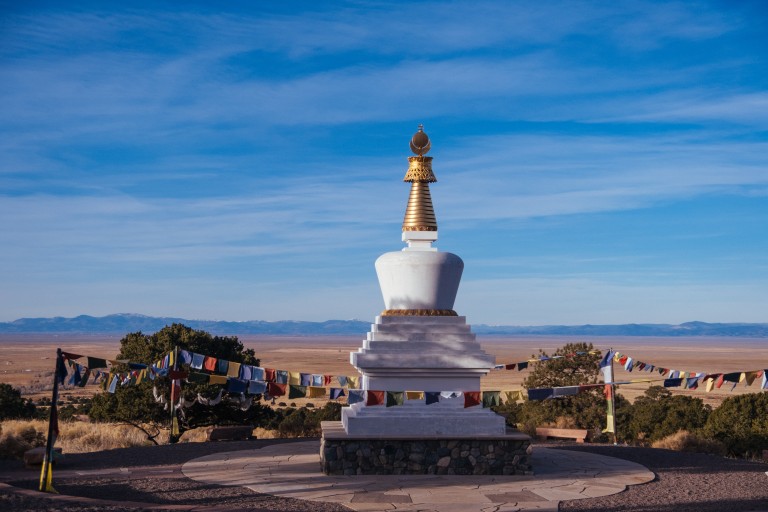
The Three Vehicles in the Modern West
Sometimes, when I step back and look at the spiritual landscape of the West, I’m struck by how quietly radical it is that the full breadth of Buddhism—its depth, its discipline, its heart—has taken root here in all its diversity. We’re living in a moment where the great streams of the Dharma that once flowed through Tibet, India, China, Japan, and Southeast Asia now run side by side in our own neighborhoods, studios, sanghas, and living rooms.
And yet, for many of us, these “three vehicles”—Theravāda, Mahāyāna, and Vajrayāna—can still feel mysterious, like distant mountains we’ve heard about but never fully seen.
What has surprised me again and again, through years of interviews and traveling across the country, is how each vehicle manifests uniquely in the West: sometimes faithfully preserved, sometimes creatively adapted, sometimes struggling, sometimes flourishing. Each reveals something about who we are as modern practitioners and what we’re longing for.
As part of making this project truly inclusive, I invite you—warmly and wholeheartedly—to share an image from your own lineage or tradition, so we can honor the full spectrum of Buddhist practice alive in the West today.
Below, you’ll find gentle introductions to each vehicle, along with an invitation to explore the people, traditions, and living practices that keep these ancient teachings alive.
THERAVĀDA: Returning to the Roots
There’s a simplicity to Theravāda that feels like a deep exhale—an invitation to strip life back down to what’s real. In so many of the Western communities I’ve visited, Theravāda shows up as grounded, unpretentious, and quietly powerful. It offers a kind of honesty we don’t often give ourselves permission to feel.
Here, the emphasis on mindfulness, early teachings, and the direct cultivation of wisdom resonates with those longing for clarity in a world overflowing with noise.


MAHĀYĀNA: The Path of Compassion in Motion
If Theravāda is the still pool, Mahāyāna is the river that keeps widening. In the West, this vehicle often meets us at the intersection of everyday life and boundless compassion—sometimes through Zen’s stark beauty, other times through Pure Land’s devotional warmth, or the many hybrid communities shaped by immigrant lineages and new forms of lay practice.
What moves me is how Mahāyāna keeps asking the same impossible question:
How can one life be lived for the benefit of all beings?
And how people answer that question—through their work, their relationships, their quiet acts of courage—has become one of the most inspiring threads in this project.
VAJRAYĀNA: The Lightning Path in a Modern World
Vajrayāna carries a kind of raw electricity—ritual, imagery, devotion, fierce wisdom, tender-hearted compassion—all braided together into practices that can feel both ancient and startlingly alive. In the West, it has often arrived through Tibetan refugee communities, through Western practitioners who found their teachers across oceans, and through the slow, careful transplantation of lineages built on relationship and transmission.
What I’ve witnessed is that Vajrayāna tends to attract those who feel called, almost magnetically, toward depth—toward the possibility that our lives can be transformed from the inside out, not someday, but now.