Feature essay · Taradhatu
A dance of devotion
The Tara Mandala Dance and the feminine wisdom of the Dharma—told through Clare, Amber, and Phyllis.
Tara Mandala Dance: Embodying the Feminine Wisdom of the Dharma

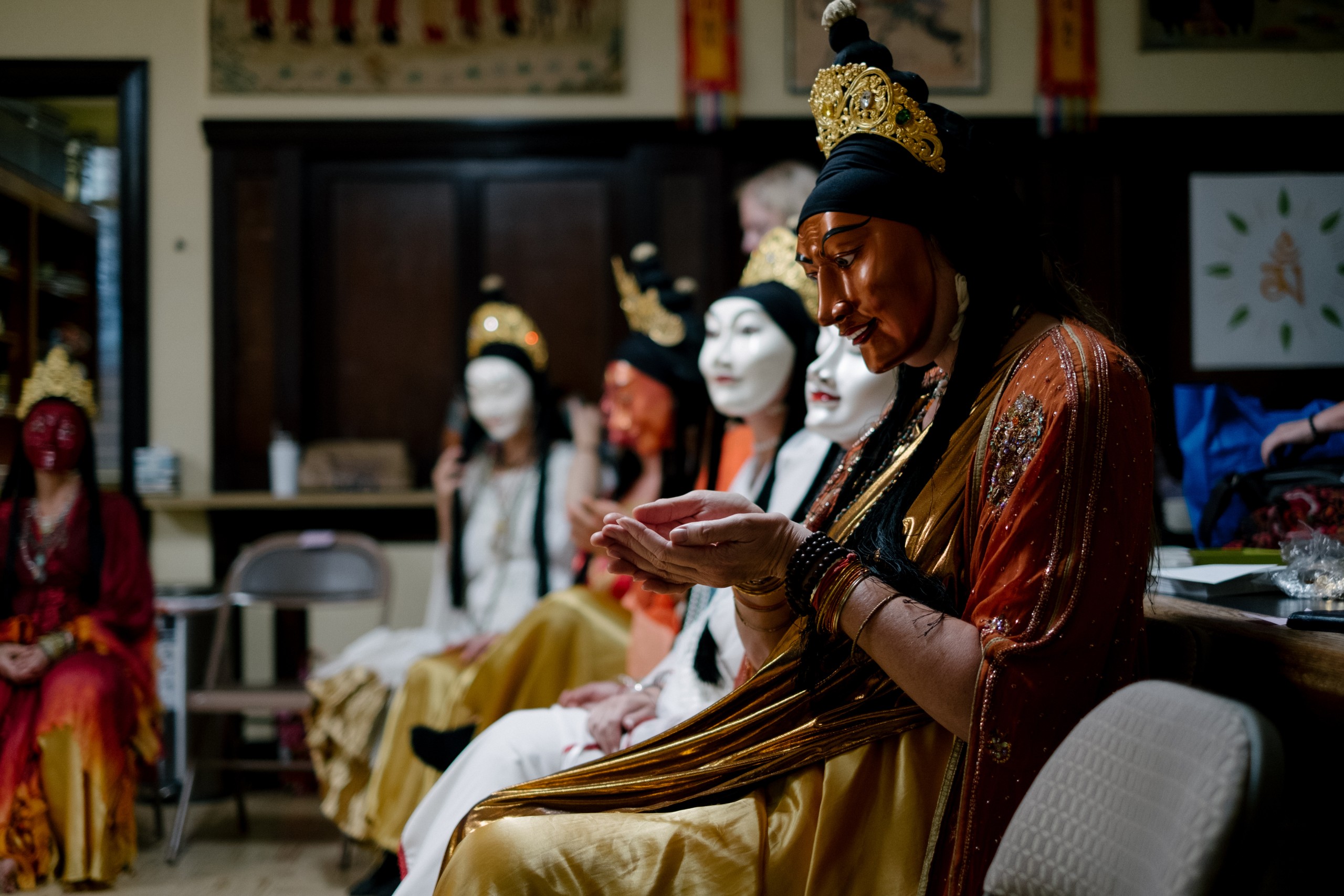
Masked dancers in red, green, and gold raise their hands together before the shrine as the dance begins.
There is something especially powerful about a spiritual practice that does not begin with explanation. It begins with movement. A body stepping into a circle. A voice chanting. A hand gesture offering blessing. A practitioner imagining Tara not as an abstract deity somewhere far away, but as a living presence that can be felt, invoked, and embodied.
The Tara Mandala Dance, as described by Clare, Amber, and Phyllis, is one of those rare practices that carries the Dharma out of the purely intellectual realm and into the body. It is meditation, prayer, visualization, devotion, and community all woven together. It asks the practitioner not simply to understand Tara, but to move as Tara. To feel wisdom and compassion not as ideas, but as qualities that can arise through breath, gesture, rhythm, and intention.
Tara Dhatu, the nonprofit organization that supports and preserves this practice, describes itself as “a non-profit organization, an international community, and a sacred vehicle for the liberation of all beings.” Its work is dedicated to uplifting humanity through sacred arts, especially dance, music, meditation, prayer, and service. The organization was formed at the request of Tai Situ Rinpoche after he witnessed the Dance of the 21 Praises of Tara, choreographed by Prema Dasara, and asked that an organization be created to protect the integrity of the dance as a “Vehicle of Liberation.” Since 1985, Tara Dhatu says the dance has traveled throughout the world through workshops, trainings, celebrations, pilgrimages, humanitarian projects, and offerings to Tibetan teachers, including His Holiness the Dalai Lama.
At its core, the Mandala Dance of the 21 Praises of Tara is described by Tara Dhatu as a ritual dance offered worldwide as a prayer of peace, protection, wisdom, and capability. It is based on a Tibetan Buddhist sadhana of Tara, and the practice begins with refuge, bodhicitta, visualization, mudras, purification, mantra, dedication, and the offering of blessing outward to all beings. Tara Dhatu emphasizes that the dance is not merely performance; it is a tantric process in which the dancer first relates to Tara as an enlightened presence, then recognizes all beings as aspects of Tara, and finally experiences herself as Tara.
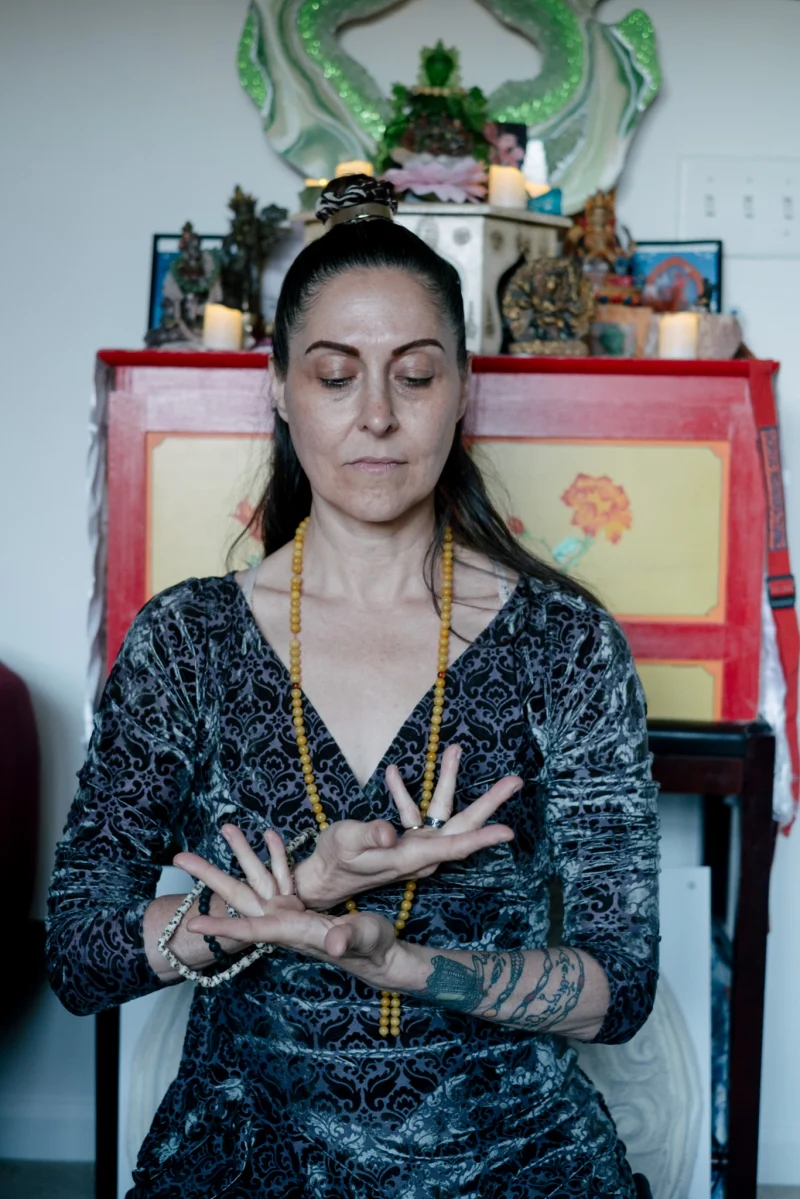
That is the heart of what Amber describes so vividly. Before encountering Tara dancing, she had known sitting meditation, chanting, puja, drumming, and walking meditation. But dance meditation was different. It was not just another form of movement layered onto Buddhist practice. It was “body, speech, and mind all coming together.” For Amber, the dance makes the abstract tangible. The visualization of countless tiny Taras coming closer, the feeling of Tara pouring unconditional love and light into the practitioner, and the gradual dissolving of the boundary between self and deity all become a lived experience. In her words, it is not about worshiping Tara from a distance; it is about allowing Tara’s love to dissolve the egoic barrier between practitioner and awakened presence.


This is where the Tara Mandala Dance reveals something essential about Vajrayana. In many forms of Buddhist practice, we can remain subtle spectators of ourselves. We sit. We observe the breath. We watch the mind. But in this practice, the whole person is invited in. Amber speaks of the dance as an alchemy of movement, voice, visualization, and breath. For her, Vajrayana is not just about sitting still and contemplating; it activates the entire being. “When I dance, I am Tara,” she says. “I don’t just pray to her—I become her.”
That statement may sound bold from the outside, but within Vajrayana it points toward a profound truth. The deity is not treated merely as an external object of devotion. Tara represents awakened qualities already latent within the practitioner: compassion, wisdom, fearlessness, protection, responsiveness, and enlightened activity. The dance becomes a way of remembering what is already present but obscured. It does not ask the practitioner to invent holiness. It asks her to uncover it.
Clare’s reflection approaches the dance from a slightly different angle. Tara had been a guiding star for her even before she encountered the dance. She had spent years doing Tara Puja, sitting on the cushion, reciting the prayer, and appreciating its beauty after her teacher translated it into English. When she first heard of a dance version of the practice being taught in Hawaii, she was curious but unsure how it could work. Years later, seeing a poster for Tara Dance, something clicked: “this is it.”
For Clare, the dance expanded her understanding of visualization. It was one thing to sit on the cushion and imagine Tara. It was another thing to see the person in front of her as Tara, to imagine Tara’s essence in their heart, and to experience the practice through the whole body. The environment itself becomes transformed into a pure realm: beautiful, radiant, filled with flowers, beyond ordinary material perception. The arms bless the world. The body draws Tara’s energy into the heart. The practice becomes physical, spiritual, imaginative, and relational all at once.
This is important because modern practitioners often struggle with practices that appear too ritualized, too mythic, or too symbolic. Many Westerners are trained to value what can be explained, measured, and defended intellectually. The Tara Mandala Dance asks for a different kind of intelligence. It asks the practitioner to enter the symbolic world sincerely enough that the symbol can work on them. Clare’s experience suggests that the dance is not less serious because it is beautiful, joyful, or embodied. In fact, its beauty is part of its method. It opens perception. It softens the heart. It allows the practitioner to see others differently.
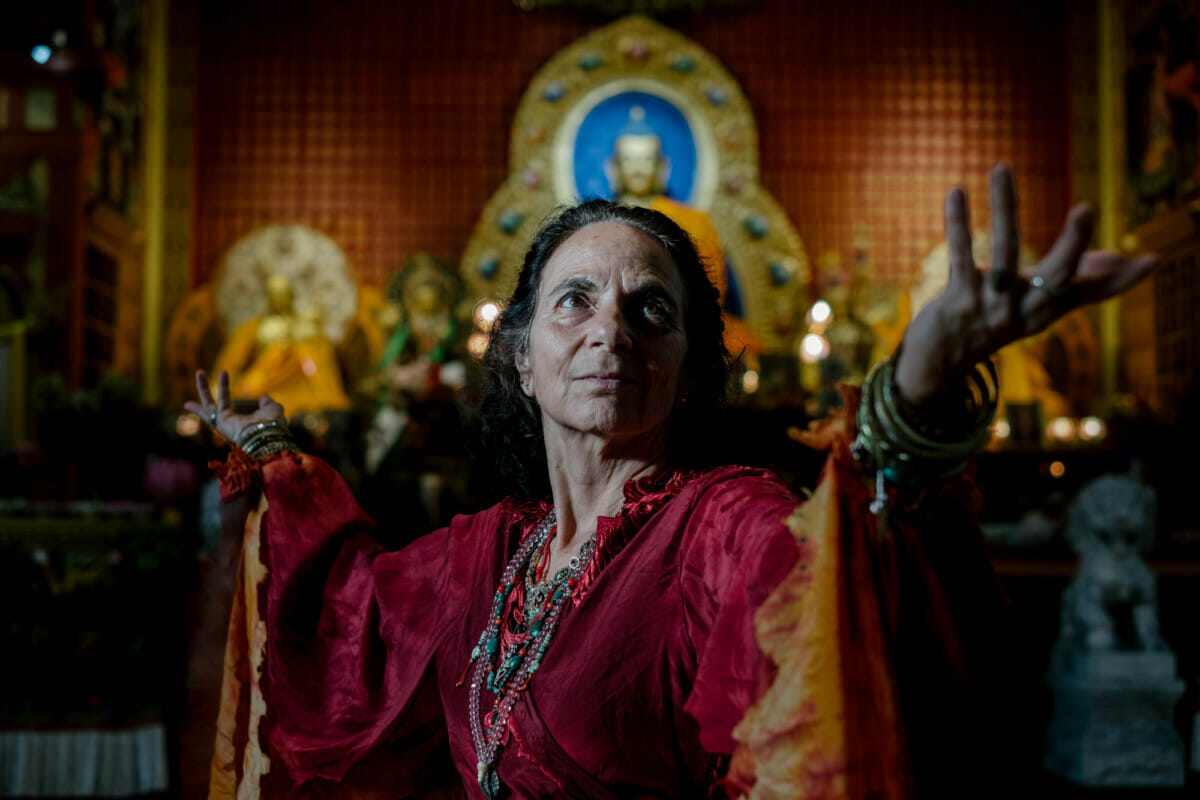
Phyllis brings another dimension: the communal and transformative power of the mandala itself. Her first encounter with the Dance of the 21 Praises of Tara took place on a cliff in Kauai, with the grass beneath the dancers and the ocean behind them. She was moved by the devotion and by what she called “Moana,” an unseen essence or spiritual potential that could be felt but not easily named. At first, she felt too shy to imagine herself dancing in front of others. But over time, the practice drew her in.
For Phyllis, the dance is not only personal practice but also a field of inclusion. She describes women gathering to dance, with men participating as protectors around the circle. She also emphasizes that the dance can draw in people who might not otherwise be interested in Buddhism or meditation. Some are attracted by beauty. Some by the joy of dressing up. Some by the devotional atmosphere. Some are simply moved and do not know why. This matters because the Dharma, in its living form, often reaches people before they have language for it. The body understands something before the mind can explain it.
Phyllis also witnessed the dance’s capacity to transform people in unexpected ways. She recalls a woman who was initially dismissive of the practice but ended up crying without understanding where the tears came from. She describes another participant, later understood to be autistic, who struggled with spatial movements but gained confidence and independence over time. She also speaks of women with disabilities, including those in wheelchairs, being welcomed into the practice. For Phyllis, the mandala is not a closed spiritual performance for the already skilled. It is a space where many kinds of bodies and minds can participate.
This reflects one of the deeper strengths of Tara Dhatu’s work. The organization presents the dance as a global, communal practice that has been taught to thousands of women and men, including Tibetan nuns and laywomen. Tara Dhatu’s educational program trains dance leaders, supports local circles, and maintains an international network of practitioners. The practice has also adapted to modern conditions through in-person gatherings, public offerings, and virtual community.
There is a beautiful tension here. The Tara Mandala Dance is rooted in Tibetan Buddhist sadhana, lineage, mantra, visualization, refuge, and bodhicitta. At the same time, it is carried by lay practitioners, artists, householders, women, men, elders, people with disabilities, and people entering through curiosity rather than formal religious identity. This is exactly the kind of living Buddhism that matters in the modern world. Not a museum of forms, but a practice that breathes.

Amber says this directly: “We don’t want a museum of Buddhism; we want living Buddhism.” For her, Tara dancing shows how adaptable and alive Dharma can be. It dissolves barriers of gender, age, and identity, uniting people through devotion to the divine feminine. She frames the practice as an antidote to the destructive force of toxic masculinity, calling forth waves of love, compassion, and feminine wisdom into the world.
The feminine principle is central here, but not in a narrow or exclusionary way. Tara is not simply “female” as a biological category. She is enlightened activity, compassion, wisdom, protection, beauty, fierce responsiveness, and liberating power. Tara Dhatu notes that many qualities associated with Tara—protection, wisdom, victory—are often stereotypically coded as masculine in Western thought. Seeing these qualities as feminine allows both women and men to develop a more balanced view of power and sacred embodiment.
“We don’t want a museum of Buddhism; we want living Buddhism.”
This is one reason the dance feels so relevant now. We live in a time where many people are disconnected from their bodies, suspicious of religion, overwhelmed by abstraction, and hungry for practices that feel both meaningful and alive. Tara Mandala Dance offers a path where devotion does not have to be rigid, where beauty is not superficial, where movement is not separate from meditation, and where feminine wisdom is not ornamental but central.
From Clare, we see how the dance transforms perception. The person in front of you becomes Tara. The room becomes a pure realm. The gesture becomes blessing. The body becomes a vehicle of practice. From Amber, we see how the dance becomes refuge, emotional medicine, and a direct way to embody Tara’s qualities. From Phyllis, we see how the mandala becomes community: inclusive, healing, and capable of reaching people beyond the usual boundaries of Buddhist practice.
Taken together, their reflections show that Tara Mandala Dance is not simply a beautiful ritual. It is a path of integration. It brings together body, speech, and mind. It brings together tradition and creativity. It brings together devotion and direct experience. It brings together the individual practitioner and the collective field of blessing.
And maybe that is why the dance leaves such an impression. In a world where spirituality is often reduced either to private self-improvement or abstract belief, Tara Mandala Dance offers something fuller. It says: bring your body. Bring your voice. Bring your imagination. Bring your grief, joy, awkwardness, longing, and devotion. Step into the mandala. Let the practice move through you.
Audio overview
Listen to the narrative exploring this essay in podcast format.
Voices in this essay
Hear their full stories

Step into the mandala
Not as performance. As offering. As transformation. As Tara.