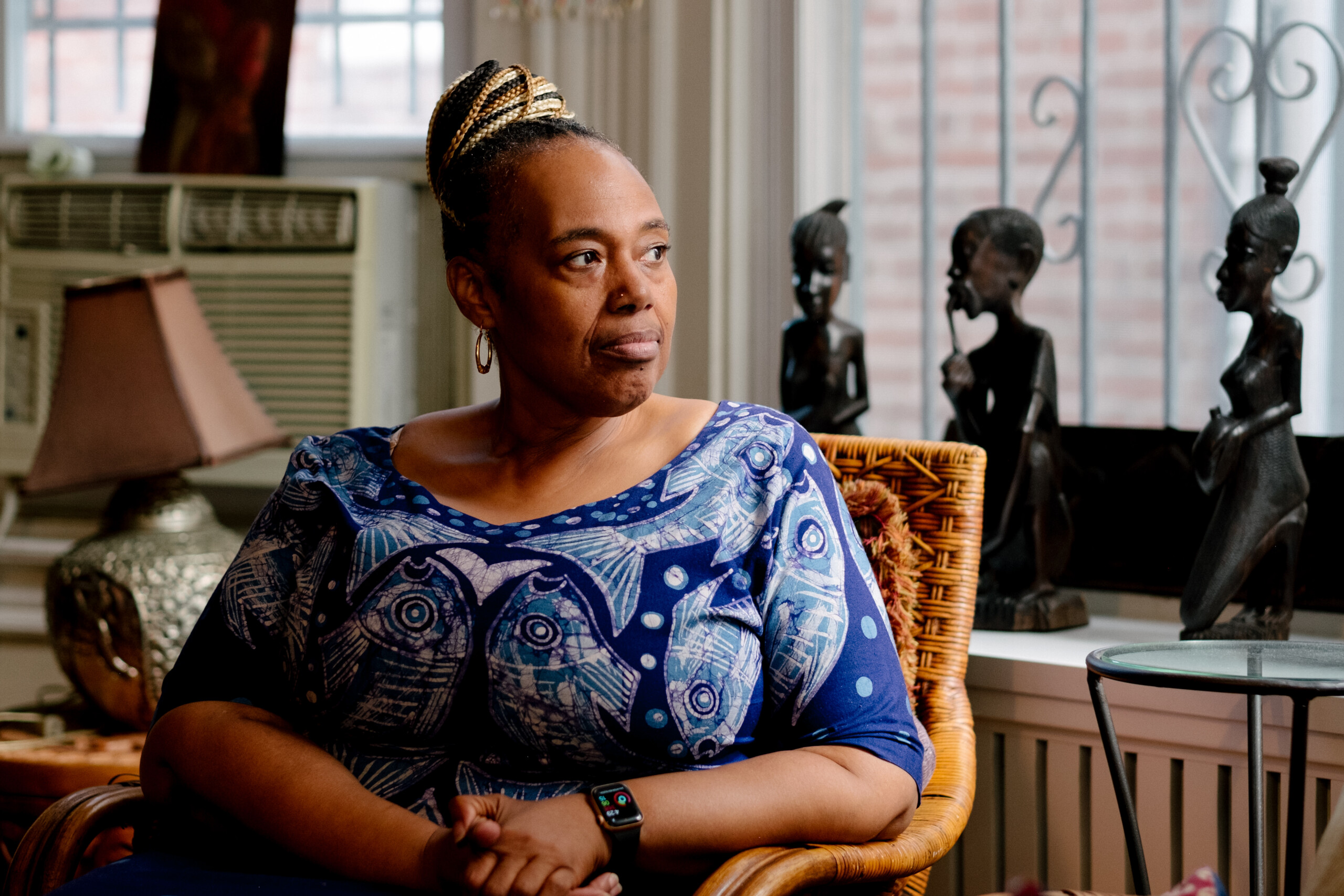
Lennell
Phoenixville, PA
Psychologist and professor Lennell Dade shares how her journey through multiple spiritual traditions led her to Won Buddhism, where meditation became a lived path of self-knowledge, compassion, and inner transformation. Her story explores the intersection of psychology, African philosophy, and Buddhist practice, offering a compelling perspective on awakening through everyday life.
Background
Dr. Dade, born and raised in Philadelphia, navigated a childhood marked by her mother’s conversion to Jehovah’s Witnesses, introducing her to a non-traditional upbringing. Despite her family’s diverse religious backgrounds, Lanell found solace in academia, eventually becoming a psychology professor.
Her academic journey led her to a predominantly white university, where she faced racism, prompting a search for fellowship and spiritual connection. Lennell explored various religions, including Jehovah’s Witnesses, Hebrew Israelites, Nation of Islam, Hare Krishna, traditional African religions, and more. Dissatisfied, she earned her master’s degree, returned to Howard University for her Ph.D., and continued her religious exploration.
Teaching psychology and African philosophy, Lennell realized the interconnectedness between the two. Struggling with personal fulfillment, she sought deeper meaning and eventually found herself drawn to Buddhist practices. A chance encounter with monks and a visit to the Won Temple sparked a profound spiritual experience, leading her to embrace Won Buddhism.
Through practicing Buddhism, Lennell not only found personal peace but also integrated practical aspects into her teachings. She redefined the concept of “Man know thyself” as “Soul knowledge,” recognizing the importance of experiential understanding. This journey transformed her approach to both life and education, allowing her to share a more profound and practical wisdom with her students.
Voice & Presence
Teachers
Lennell reflects on her experience with Won Buddhism, drawing parallels between the commitment to study in Jehovah’s Witnesses and the importance of practice in Buddhism. In the racially charged society she navigates, she observes the diversity within Buddhist settings and emphasizes the need for practice to address issues of racism, sexism, and more. As a black woman facing societal stereotypes, Lennell shares how Buddhism encourages understanding motives behind actions and fostering a wholesome approach to challenges.
She discusses the beauty of Buddhist doctrines in addressing societal issues but emphasizes that true change requires dedicated practice. She shares personal experiences of both positive and challenging interactions within Buddhist circles, highlighting the importance of embracing opportunities for growth.
Challenges
Lennell, drawn to the symbolic significance of the Dharmakaya in Won Buddhism, resonates deeply with the circular representation of life. Influenced by her cultural upbringing and studies in African philosophy, Lanell finds connection in the circular philosophy, transcending cultural boundaries.
Service
Lennell, who now goes by the name Jin Sun, shares her transformative journey through Won Buddhism, emphasizing the profound connection between inner exploration and outward service. Rooted in her cultural upbringing and studies in African philosophy and psychology, Jin Sun reflects on the importance of genuine service and the challenge of getting out of one’s own way.
Buddhism in America
Lennell emphasizes the influence of a Western European filter on the understanding of Buddhism in the American landscape. She scrutinizes the reinterpretation and selectivity that occurs as Buddhism integrates into American culture. Concerned about the individualistic interpretation of Buddhism in the U.S., Lanell appreciates the focus on Dharmakaya Buddha in Won Buddhism, contrasting it with the concentration on the image of Buddha that often leads to divisive arguments.
She notes the importance of being mindful as Buddhism undergoes translation and reinterpretation, questioning the origins of the term “Buddhism” and the potential distortion of its essence by Western interpretations. Lennell underscores the misunderstanding of Buddhism as individualistic, advocating for a deeper understanding that going inward is a means to transcend the mind rather than a self-serving endeavor.
In her critique, Lennell calls for caution to prevent Buddhism from deviating and losing its true essence, akin to other religions that have strayed from their core principles. Her insights highlight the need for awareness and discernment as Buddhism continues to evolve in different cultural contexts.
Application
Lennell reflects on her dual roles as a teacher and her future plans, considering retirement after 26 years at Lincoln. With a Ph.D. in psychology and a master’s degree in Buddhism, she contemplates teaching at the Wine Institute and engaging in lay teaching. Inspired by personal connections, she expresses interest in working with the prison population, drawing on her brother’s incarceration and the unique opportunities for mental freedom within physical confinement. Additionally, Lanell is intrigued by hospice care, specifically assisting family members in coping with transitions.
Not strictly categorizing Won Buddhism as a religion or philosophy, Lennell sees it primarily as a way of life, emphasizing its applicability beyond academic or religious boundaries. With a passion for sharing its teachings with those who may be suffering, she envisions incorporating these principles into her interactions with others, offering guidance based on her personal experiences and the transformative impact of mindfulness on mental well-being.
Learn more
Registration is required to view the complete profile and support the project.
Share This Story, Choose Your Platform!
Other Portraits

David M on Vajrayana Buddhism: Finding Freedom Through Curiosity, Death, and Direct Experience
Nancy’s Journey into Tibetan Buddhism: Compassion, Devotion, and Transformation Through Practice
Ani Palmo: From Catholicism to Tibetan Buddhism | A Journey of Wisdom, Compassion & Practical Dharma
Lisa Ernst on Insight Meditation, Trauma, and Building a Compassionate Buddhist Community
Mark G: How Insight Meditation Transforms Everyday Life
Mara’s Journey Through Grief: How Buddhist Practice and Sangha Transformed Loss
Kim’s Buddhist Journey: Mindfulness, Resilience, and Finding Peace Through Vipassana Practice
From Christianity to Vajrayana Buddhism: Elinore’s Journey of Compassion, Karma, and Inner Transformation
Liz | From Fashion to Dharma: Building Samaya Through Tibetan Buddhist Practice